OTAs bring bookings hotels wouldn’t otherwise get, and the commission they charge for that is a normal, accepted cost of doing business. What’s not normal — and what most properties never actually check — is whether the commission charged on any given booking matches what it should have been.
It usually doesn’t get checked, because checking it means comparing the original booking terms against the remittance, folio by folio, every single time. Almost no property does that by hand consistently. Which means almost no property actually knows how much OTA commission error is costing them.
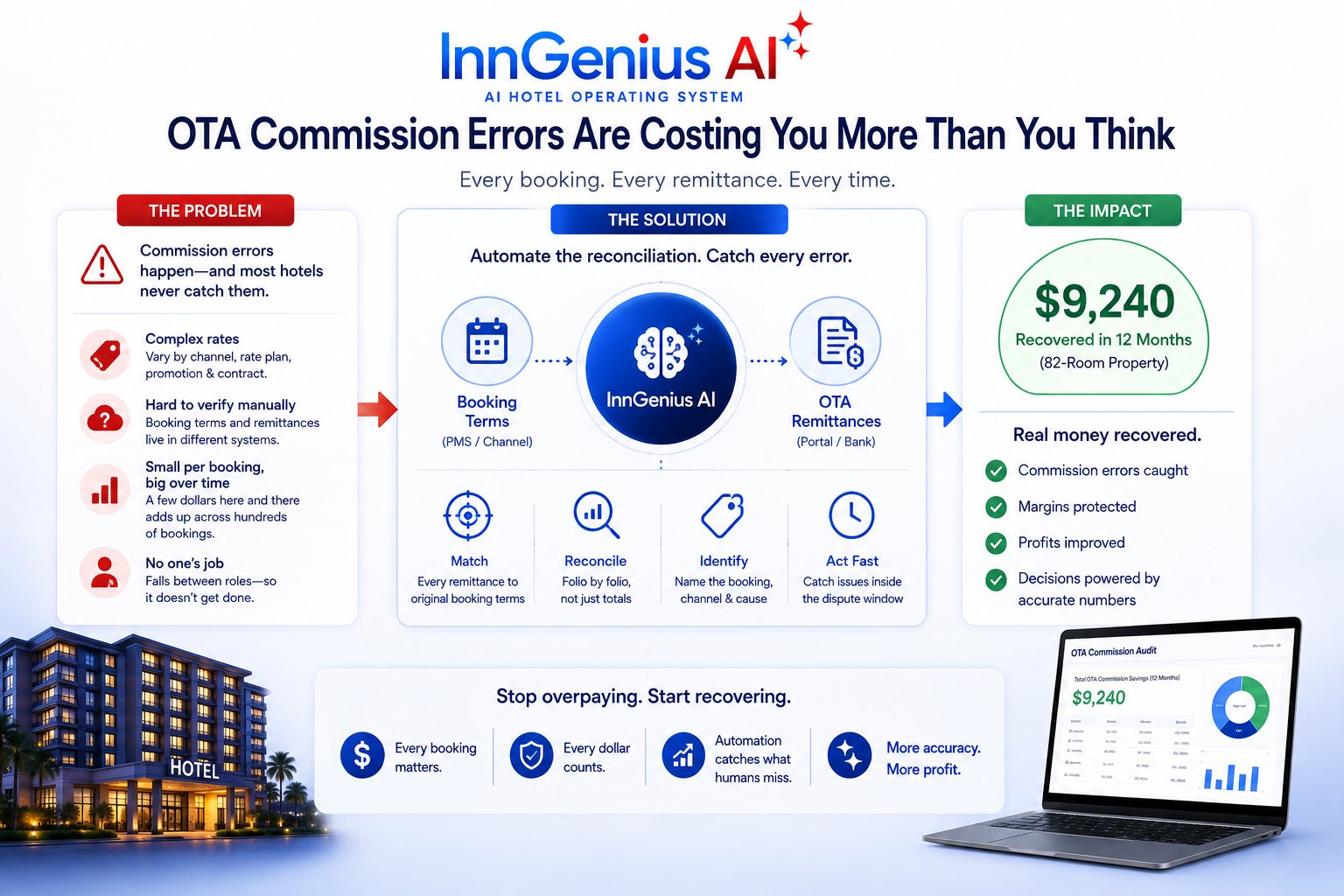
OTA commission isn’t a single flat rate. It varies by:
None of this is fraud. It’s complexity — enough moving parts that a mismatch between what should have been charged and what actually was charged is the expected outcome of a manual process, not an edge case.
Most other billing errors get caught because someone notices a number that looks wrong. OTA commission errors don’t work that way, for a few reasons:
The remittance looks plausible on its own. A commission deduction that’s off by a percentage point or two doesn’t look broken — it just looks like a normal commission charge, because nobody has the original booking terms open side-by-side with the remittance to compare.
The check requires two data sources that live in different systems. The booking terms live in the PMS or the channel manager. The remittance lives in an OTA portal or a bank statement. Actually verifying a commission means pulling both and comparing them line by line — for every booking, not just the ones that seem off.
It’s small per booking, but constant. A few dollars of variance on one reservation isn’t worth a bookkeeper’s time to chase down. Multiplied across hundreds of OTA bookings a month, it’s a meaningful number — but nobody sees it that way because it never gets aggregated.
Nobody’s job is specifically to check this. A bookkeeper closes the books. A GM runs the property. Auditing OTA commission line-by-line against contract terms falls into the gap between those roles — it’s nobody’s specific responsibility, so it doesn’t happen.
On a trailing twelve-month profit audit for one 82-room property, forecasted OTA commission savings alone came to $9,240 — the single largest recovery category, ahead of duplicate invoices, rate parity variance, and avoidable overtime combined with each other individually. That’s not a one-time catch; it’s the kind of number that accrues month after month for as long as nobody’s checking.
Scaled across a portfolio, or compounded over years a property has been on OTA channels without a systematic reconciliation process, the number gets considerably larger — and it’s money that was never stolen or fraudulent, just never verified.
Catching OTA commission errors reliably requires doing the same comparison a bookkeeper would do manually, but for every single booking, every time:
Match each remittance to its original booking terms. The rate plan, the channel, the commission percentage that should have applied — checked against what was actually deducted, not assumed to be correct because the total looks reasonable.
Reconcile OTA remittances folio by folio, the same way a bank statement gets reconciled line by line, rather than accepting the OTA’s summary total as accurate. We cover the same discipline applied across all of bookkeeping in our piece on the hidden cost of manual bookkeeping.
Name the variance, not just the total. A useful reconciliation doesn’t just say “commission was $X higher than expected” — it identifies which booking, which channel, and why, so it’s actually actionable rather than a mystery number.
Do it continuously, not at audit time. Errors caught a year later are still worth recovering where possible, but errors caught the same week they happen are errors that can actually be disputed with the OTA before the window closes.
If you want a sense of whether this is happening at your property before investing in a fix:
If the honest answer is “we’ve never specifically checked this,” that’s not unusual — it’s the default state for most independent hotels. It’s also exactly the gap worth closing.
OTA commission is a real and reasonable cost of running a hotel. OTA commission error is not — and it’s specifically the kind of cost that survives because verifying it correctly requires a level of consistent, transaction-by-transaction checking that manual processes were never built to sustain. For one property, that gap was worth $9,240 in a single year. The only real question is whether anyone’s actually looking for it at yours.
InnGeniusAI is the AI hotel operating system that runs your night audit, your books, and your schedule — on one shared ledger, with every number traceable back to its source.
Explore the platformSee every remittance reconciled folio by folio, against the original booking terms, automatically.
Book a demo
Seventeen AI workspaces, from the room board to the general ledger — the AI hotel operating system.
© 2026 InnGenius AI LLC · AI Hotel Operating System · Greensboro, NC
Founding pricing locked for the first 300 properties — see the whole flow in 20 minutes.
Book a demoBefore we start — mind sharing your name and email? I’ll only pass it to a real person if you want a follow-up.