

Labor is usually the single largest line item on a hotel’s P&L — bigger than utilities, bigger than OTA commissions, often bigger than the mortgage. And within labor, overtime is the part that’s almost entirely avoidable, yet it shows up on nearly every property’s books anyway.
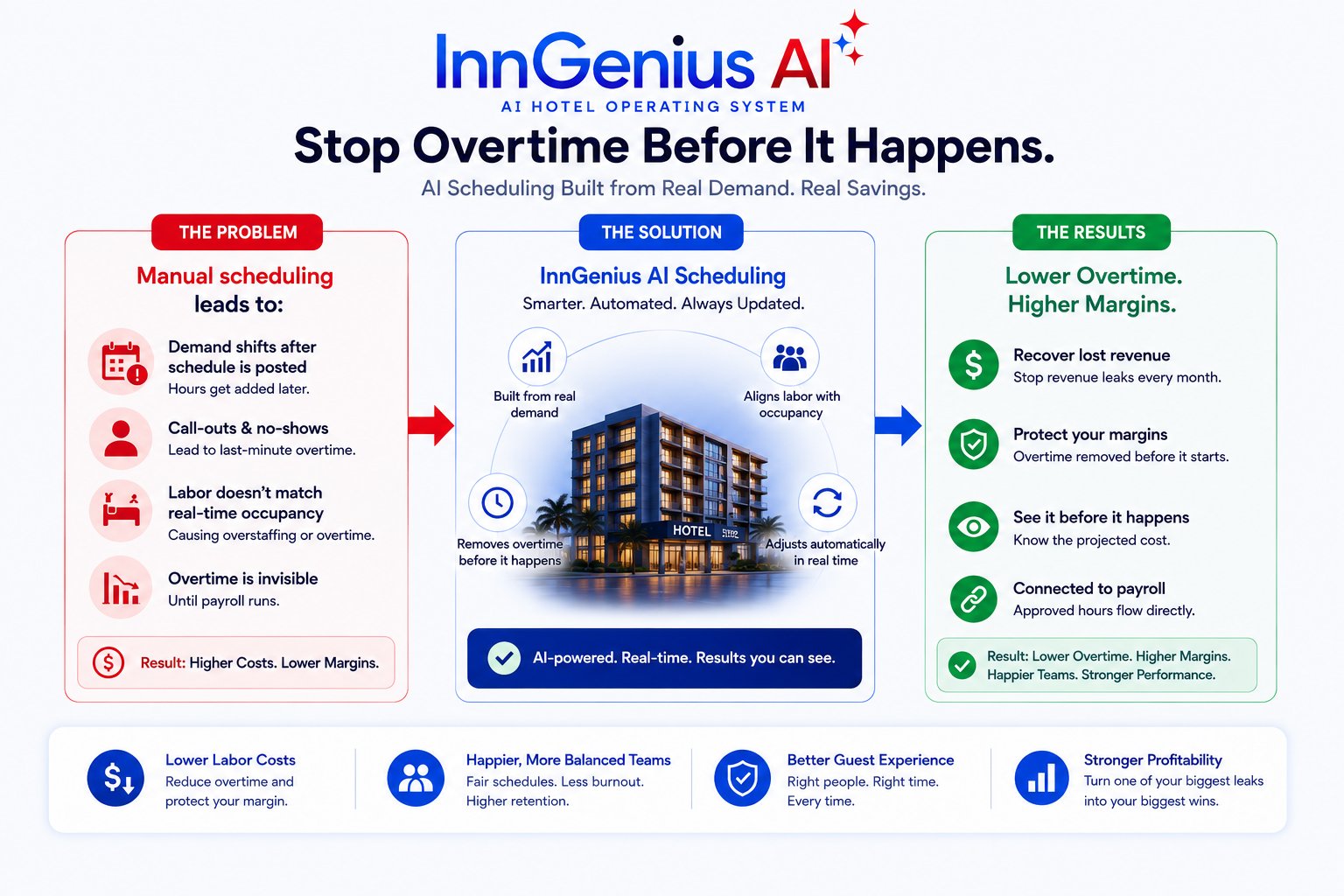
Not because managers are bad at scheduling. Because manual scheduling is structurally unable to see overtime coming until it’s already too late to stop it.
A typical week gets scheduled from a template — last week’s schedule, adjusted a little for what the GM remembers about upcoming demand. That’s not a criticism; it’s the only realistic option when scheduling is done by hand. But it means the schedule is built on a guess, not on the numbers.
A few things happen from there, almost every week:
Demand shifts after the schedule is posted. A group books late, a weekend fills up faster than expected, a slow Tuesday turns into a busy one. The schedule doesn’t move with it — someone just gets called in, or an existing shift runs long.
Call-outs get covered reactively. Someone’s sick, someone’s late, and the fastest fix is asking whoever’s already on shift to stay. That’s overtime, decided in the moment, with no visibility into what it costs until the pay period closes.
Housekeeping and front desk staffing don’t track occupancy in real time. Rooms get assigned and cleaned based on a static plan, not the actual number of departures and arrivals that day, so the labor plan is often solving yesterday’s occupancy, not today’s.
Nobody sees the overtime total until payroll runs. By the time a GM or owner sees the number, the hours are already worked and already owed. The only thing left to do is explain it after the fact, not prevent it.
Individually these look like small, reasonable decisions. Added up across a month, across every property in a portfolio, they turn into one of the most consistently avoidable costs in hotel operations.
Overtime isn’t just time-and-a-half on an hourly wage. The real cost shows up in a few places at once:
On the homepage of InnGeniusAI, one property’s trailing-twelve-month profit audit shows overtime avoided through labor AI as a specific, named recovery category — alongside OTA commission errors and duplicate invoices. That’s the pattern worth paying attention to: overtime isn’t a rounding error, it’s a leak that’s large enough and consistent enough to show up as its own line in a recovery report.
The core problem with manual scheduling isn’t effort — it’s timing. A schedule built a week in advance from a template is already out of date by the time it’s posted, because occupancy and demand keep moving after that.
AI-driven labor scheduling solves this by working the other direction: instead of building a schedule and hoping it matches demand, it builds the schedule from the demand data the property already has — actual occupancy, actual bookings, actual arrival and departure patterns — and adjusts before the week starts, not after.
In practice, that looks like:
The week builds itself from real numbers. Occupancy and demand data feed directly into the schedule, so staffing reflects what’s actually booked rather than what was booked last month at this time.
Overtime gets removed before anyone works it. Because the schedule is priced against demand ahead of time, the shifts that would have triggered overtime get caught and adjusted in the plan — not discovered on the pay stub.
Downstream events adjust the plan automatically. An early checkout, a same-day cancellation, a walk-in that fills a room — each of these has a labor implication (does housekeeping need the room turned today, does front desk need coverage tonight), and a connected system adjusts the labor plan the same way it adjusts the room board and the ledger, rather than treating scheduling as a separate task someone has to remember to redo.
The owner or GM sees the overtime number before it happens, not after. A schedule that flags a projected overtime hour before the week starts gives someone the chance to actually change it — swap a shift, adjust coverage — instead of just explaining it in next month’s meeting.
If overtime is a recurring issue at your property, a few questions are worth asking before assuming the fix is “hire another scheduler” or “get stricter with staff”:
Overtime isn’t usually a staffing problem or a discipline problem — it’s a visibility and timing problem. Manual scheduling can only react to demand after it’s already happened, which means overtime gets discovered on the payroll report instead of prevented in the plan.
Scheduling that’s built directly from real occupancy and demand data closes that gap. The overtime hour that used to show up as a surprise on next month’s labor report gets caught and removed from the plan before anyone works it — which turns one of the most consistently avoidable costs in hotel operations into one that’s actually avoided.
InnGeniusAI is the AI hotel operating system that runs your night audit, your books, and your schedule — on one shared ledger, with every number traceable back to its source.
Explore the platform
Why a PMS alone isn’t enough, and what the layer underneath it actually does.
Read the article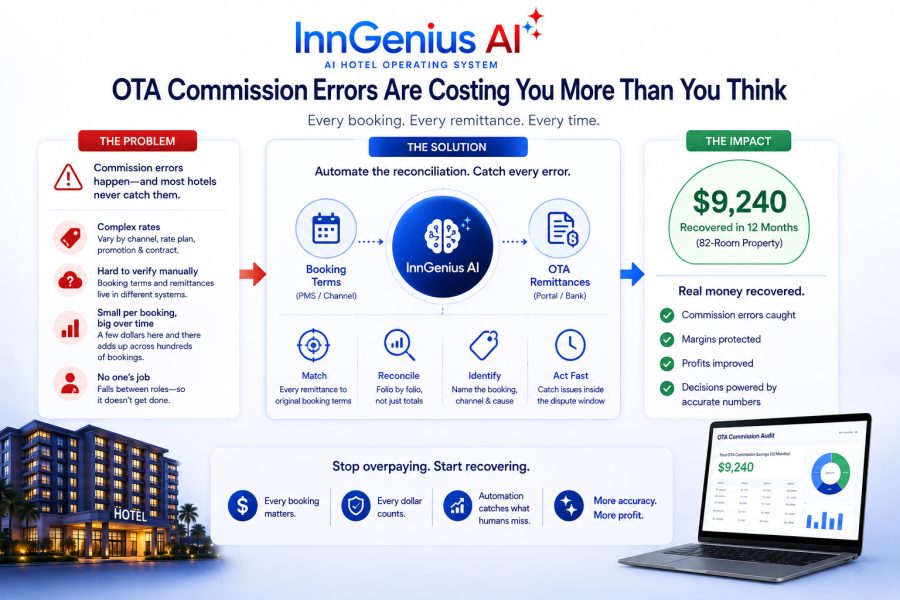
Why commission errors are the single largest recovery category, and how they actually get caught.
Read the articleSee how labor AI prices next week’s schedule against real demand, before the first shift is posted.
Book a demo
Seventeen AI workspaces, from the room board to the general ledger — the AI hotel operating system.
© 2026 InnGenius AI LLC · AI Hotel Operating System · Greensboro, NC
Founding pricing locked for the first 300 properties — see the whole flow in 20 minutes.
Book a demoBefore we start — mind sharing your name and email? I’ll only pass it to a real person if you want a follow-up.