

Ask most independent hotel owners what bookkeeping costs them, and they’ll quote you a number: the bookkeeper’s fee, or the outsourced accounting retainer. That number is real, but it’s also the smallest part of the actual cost.
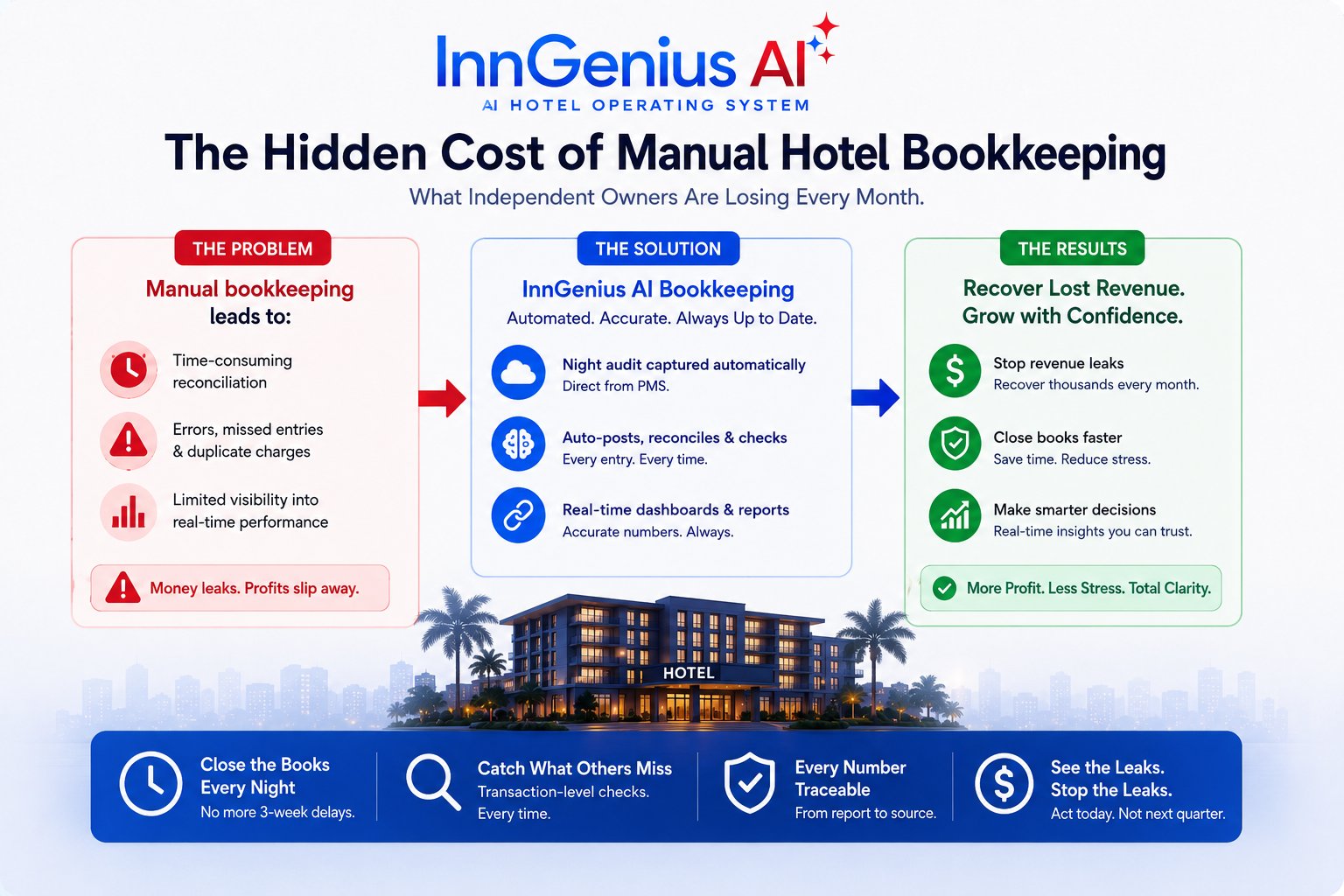
The bigger cost is everything that manual bookkeeping doesn’t catch — the errors that go unnoticed because nobody has time to check every invoice against every booking, the delays that mean owners are making decisions on numbers that are three weeks stale, and the leaks that only get found if someone happens to go looking for them.
Even at properties with a good bookkeeper, the process usually looks something like this:
Every one of these steps depends on a person having the time, the attention, and the context to catch something that doesn’t look right. Most of the time, they don’t catch it — not because they’re careless, but because manual bookkeeping is structured around getting the books closed, not around auditing every transaction for accuracy.
These are the categories that show up over and over in hotel finances, and they’re rarely caught by a monthly bookkeeping process:
OTA commission errors. Commission rates vary by channel, by rate plan, by promotion, and they change. A booking that should have been charged one rate gets billed at another, and unless someone is manually checking every OTA remittance against the original booking terms, the discrepancy just gets paid.
Duplicate invoices. Vendors resend invoices, POs get processed twice, and without a systematic match against what was actually delivered or booked, duplicates get paid rather than caught.
Rate parity variance. The rate a guest was actually charged doesn’t always match what was quoted or contracted — a small gap per booking that adds up across a full trailing period.
Avoidable overtime. Not strictly a bookkeeping category, but it shows up the same way: invisible until someone specifically looks for it, by which point the hours are already worked and paid. We cover this one in more depth in our piece on hotel overtime costs.
None of these are dramatic, one-time mistakes. They’re small, recurring gaps that manual processes are simply not built to catch consistently — because catching them requires cross-referencing data that lives in different systems, done every single time, not just when something looks obviously wrong.
This isn’t hypothetical. On a trailing twelve-month profit audit for one 82-room property, these exact categories added up to a specific, traceable total:
That’s roughly $2,000 a month, for one property, in money that a standard monthly bookkeeping process wasn’t catching — not because the bookkeeper was bad at their job, but because these are exactly the kind of cross-referenced, transaction-by-transaction checks that don’t scale to a person doing them by hand across hundreds of folios and invoices a month.
There’s a second, quieter cost to manual bookkeeping that doesn’t show up as a dollar figure on any single report: timing.
When books close weeks after the month ends, every decision an owner makes in between is based on stale numbers. Should we adjust rates? Are we overstaffed this week? Is this property actually profitable right now, or just historically profitable as of three weeks ago? Manual bookkeeping doesn’t just risk missing errors — it guarantees that whatever numbers an owner does see are already out of date by the time they see them.
For a single property, that’s an inconvenience. Across a small portfolio, it means every owner conversation is really a conversation about last month, not this one.
The categories above aren’t hard to catch in principle — they’re hard to catch consistently, at scale, by hand. That’s the specific gap automation closes:
Every invoice gets matched automatically, vendor and booking data cross-referenced the same way every time, rather than only when something looks off.
OTA remittances get reconciled folio by folio, so a commission miscalculation gets caught against the original booking terms instead of just paid. We go deeper on exactly how in our piece on OTA commission errors.
The books close the same night the audit runs, not weeks later — so an owner looking at this month’s numbers is actually looking at this month.
Every entry is traceable to its source. Instead of a report saying “revenue was X,” a system built this way lets you click through to the actual posted entry that produced that number.
The leak gets surfaced, not just corrected. A margin slip gets flagged with a cause and an owner assigned to act on it — the same day, not the same quarter.
The fee you pay a bookkeeper is the visible cost. The invisible cost is everything a manual process is structurally unlikely to catch — the OTA commission that was billed wrong, the duplicate invoice that got paid anyway, the overtime that showed up on the pay stub instead of the schedule. For one 82-room property, those invisible costs added up to over $24,000 in a single year.
That’s not a bookkeeping problem that better effort fixes. It’s a systems problem — and it’s exactly the gap automated, transaction-level reconciliation is built to close.
InnGeniusAI is the AI hotel operating system that runs your night audit, your books, and your schedule — on one shared ledger, with every number traceable back to its source.
Explore the platform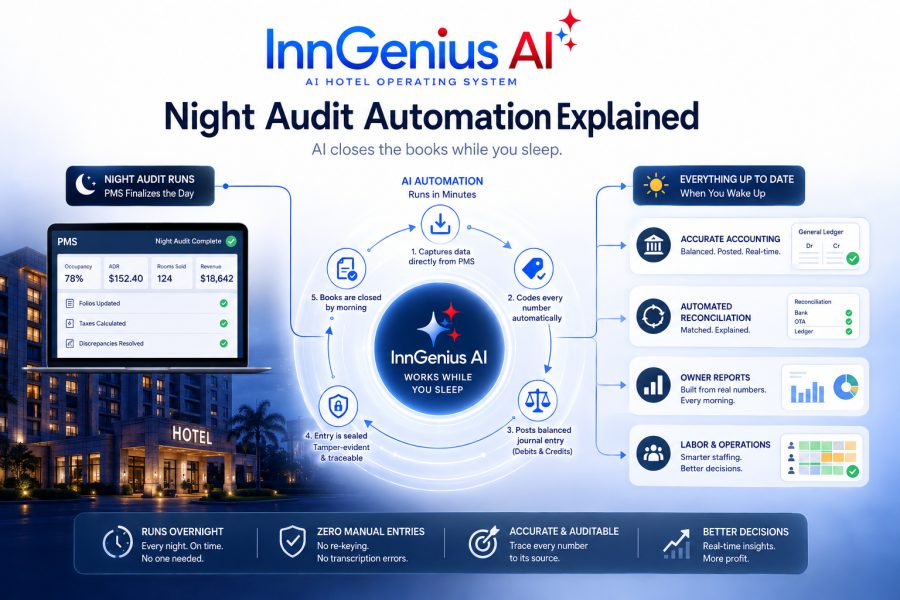
How AI closes the books while you sleep — and why a balanced, sealed journal entry beats a nicer report.
Read the article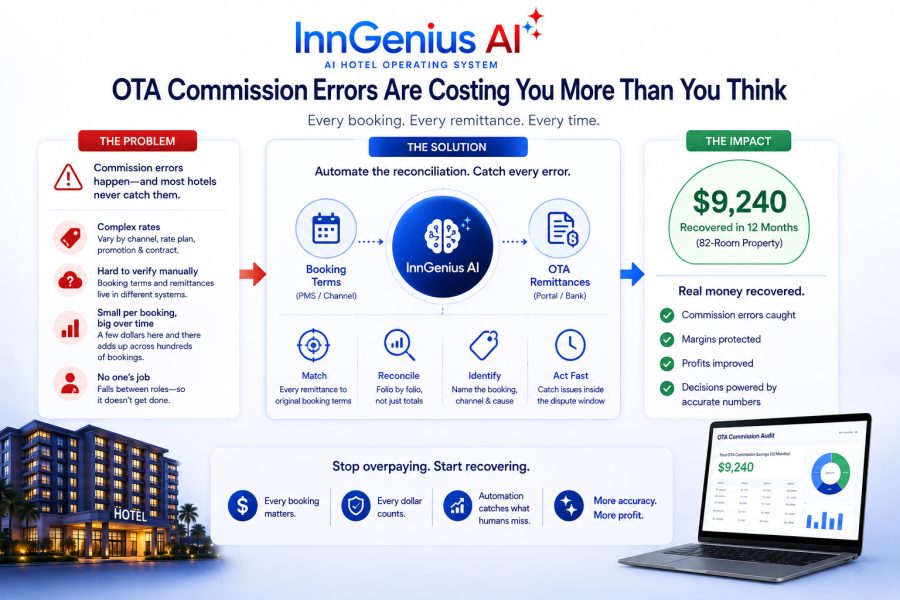
Why commission errors are the single largest recovery category, and how they actually get caught.
Read the articleConnect one property and see exactly what manual bookkeeping has been missing — traced to the entry, not just the total.
Book a demo
Seventeen AI workspaces, from the room board to the general ledger — the AI hotel operating system.
© 2026 InnGenius AI LLC · AI Hotel Operating System · Greensboro, NC
Founding pricing locked for the first 300 properties — see the whole flow in 20 minutes.
Book a demoBefore we start — mind sharing your name and email? I’ll only pass it to a real person if you want a follow-up.