Every hotel runs a night audit. It’s the one process that never gets skipped, because it’s the moment the day’s numbers become official — occupancy, revenue, tax, folios, all locked in before a new day starts. It’s also, for most properties, the moment where a human has to step in and turn those numbers into something the accounting system understands.
That handoff — from “the audit ran” to “the books are actually closed” — is where night audit automation lives. Here’s what it actually does, and why it matters more than it sounds.
The night audit isn’t just a formality. It’s the process that:
In most hotels, a night auditor (or the overnight front desk agent) runs this in the PMS, resolves whatever doesn’t balance, and hands off a report. Someone else — a bookkeeper, a controller, sometimes the GM — then has to take that report and translate it into the accounting system: which GL code does room revenue hit, which code does tax hit, does the guest ledger balance against what was actually collected.
That second step is manual almost everywhere. It’s also where errors creep in, and where the delay between “the day happened” and “the books reflect it” stretches from hours to weeks.
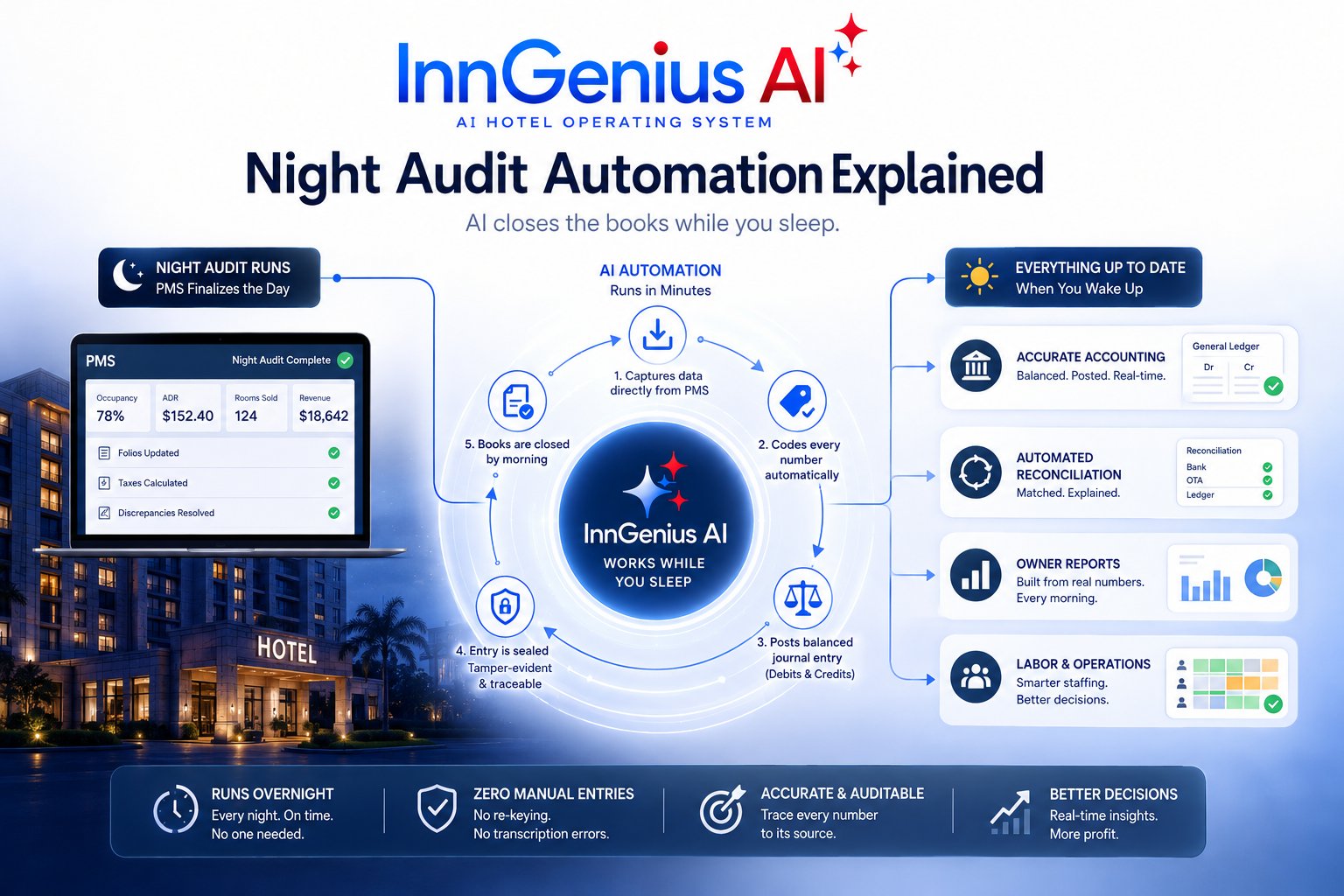
Night audit automation removes the manual translation step entirely. Instead of a person reading the audit output and keying it into accounting, the system does it the moment the audit closes — typically in the first few minutes after 3:00 AM, whenever the PMS finalizes the day.
Here’s roughly what that sequence looks like:
The audit runs. Whatever PMS the property uses — Opera, OnQ, choiceADVANTAGE, or others — finalizes the day exactly as it always has. Nothing changes on the front-desk side.
The data is captured directly from the PMS. Occupancy, ADR, rooms sold, folios, tax collected — pulled straight from the source, not exported and re-typed.
Every number gets coded automatically. Room revenue maps to the correct revenue GL code. Occupancy tax maps to the tax liability account. Guest ledger movements map to the right receivable. Anything the system doesn’t recognize — a new rate plan, an unusual charge type — gets surfaced for a human to map once, rather than silently guessed at.
A balanced journal entry posts itself. Debits and credits, both sides, down to the cent. Guest ledger debited, room revenue and tax credited — matching exactly, because it was generated from a single source rather than assembled by hand.
The entry is sealed. A tamper-evident record — often hash-chained — locks the entry in place, so it can be traced back to its source but not quietly edited later. We go deeper on exactly how that chain works in our piece on what an AI hotel operating system actually does.
By the time anyone on staff is awake, the books for that day are already closed, coded, and posted — not sitting in a queue waiting for someone to get to them.
A lot of hotel software claims automation but really just means “the report is generated automatically.” The meaningful distinction with night audit automation is whether the accounting entry itself is posted and balanced without a human checking the math.
That matters for two reasons:
Speed compounds. If closing a day’s books takes a person 20–30 minutes and there’s any backlog, “the books” can lag reality by days or weeks. An owner asking “how did we do this month” is really asking a question the system can’t accurately answer yet. Same-night posting means the books are never more than a few hours behind what actually happened.
Errors compound too. A misclassified charge or a folio that doesn’t quite balance is easy to miss in isolation, but it snowballs — a downstream reconciliation, an owner report, a tax filing all inherit that mistake. Automating the coding step doesn’t just save time, it removes the specific point in the process where manual keying errors are most likely to happen.
Night audit automation is rarely just about the journal entry. Once the numbers are posted, the same automation typically feeds into everything downstream:
That’s the real value: the night audit stops being an isolated overnight task and becomes the trigger that keeps every other part of the operation current.
If you’re looking at tools that claim to automate the night audit, a few questions separate the ones that genuinely close the books from the ones that just generate a nicer report:
The night audit was already automated in the sense that the PMS calculates the numbers on its own. What wasn’t automated — until recently — was the step after that: turning those numbers into a closed, coded, balanced set of books without a person doing the translation by hand.
That’s what night audit automation actually delivers. Not a faster report, but books that are closed, accurate, and traceable before the sun comes up — every night, for every property, without anyone keying in a single entry.
InnGeniusAI is the AI hotel operating system that runs your night audit, your books, and your schedule — on one shared ledger, with every number traceable back to its source.
Explore the platformConnect one property and see the entry post, balance, and seal itself the same night it happens.
Book a demo
Seventeen AI workspaces, from the room board to the general ledger — the AI hotel operating system.
© 2026 InnGenius AI LLC · AI Hotel Operating System · Greensboro, NC
Founding pricing locked for the first 300 properties — see the whole flow in 20 minutes.
Book a demoBefore we start — mind sharing your name and email? I’ll only pass it to a real person if you want a follow-up.