If you run a hotel, you already have a PMS. You probably have a POS, an accounting tool, a labor scheduler, maybe a BI dashboard bolted on top. And yet, at the end of every month, someone is still exporting CSVs, re-keying invoices, chasing down a rate parity discrepancy, or waiting on a bookkeeper to close the books three weeks late.
That gap — between the systems you already pay for and the actual work that still falls on a human — is exactly what an AI hotel operating system is built to close.
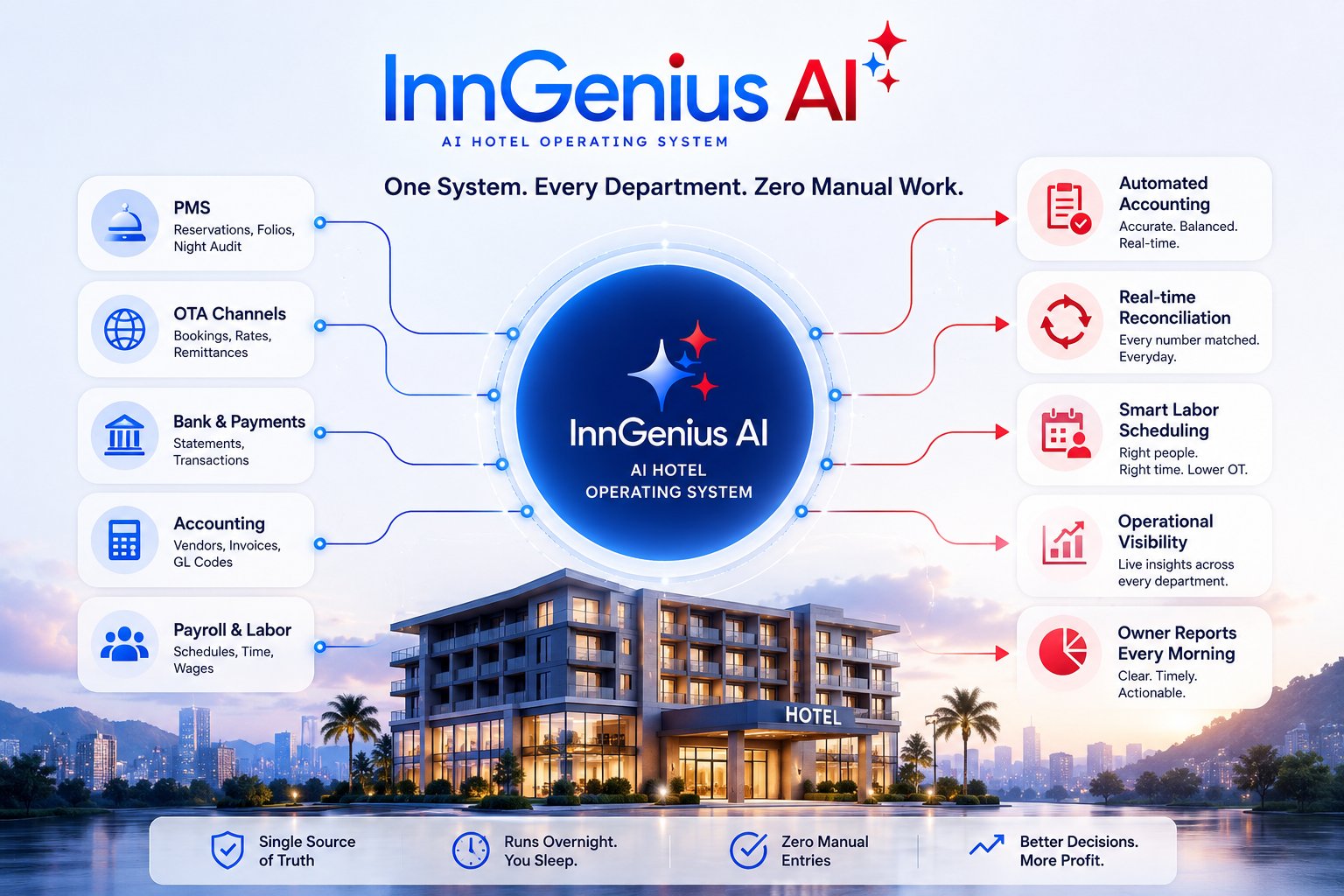
An AI hotel operating system isn’t another piece of software that sits next to your PMS, your accounting platform, and your labor tool. It’s a layer that sits across them — reading the data those systems already produce, taking the actions a person used to take manually, and posting the results back into one shared ledger. Instead of five logins and five sources of truth, you get one system that watches everything overnight and hands you a finished set of numbers by morning.
Think of your PMS as the system that runs your front desk. An AI hotel operating system is the layer that runs everything downstream of the front desk — the accounting, the scheduling, the reconciliation, the reporting — without anyone re-typing what the PMS already knows.
Here’s a fairly ordinary night at a hotel that doesn’t have this layer:
None of these steps are hard individually. But they’re repetitive, time-sensitive, and error-prone, and they all depend on a human being available, awake, and accurate. Multiply that across every property in a portfolio and you get the real cost: bookkeeping fees, overtime, missed OTA commission errors, and owner reports that arrive weeks after the numbers were relevant.
Rather than replacing your PMS, an AI hotel operating system typically connects to it — along with your bank, payroll provider, and OTA channels — and runs a set of jobs automatically:
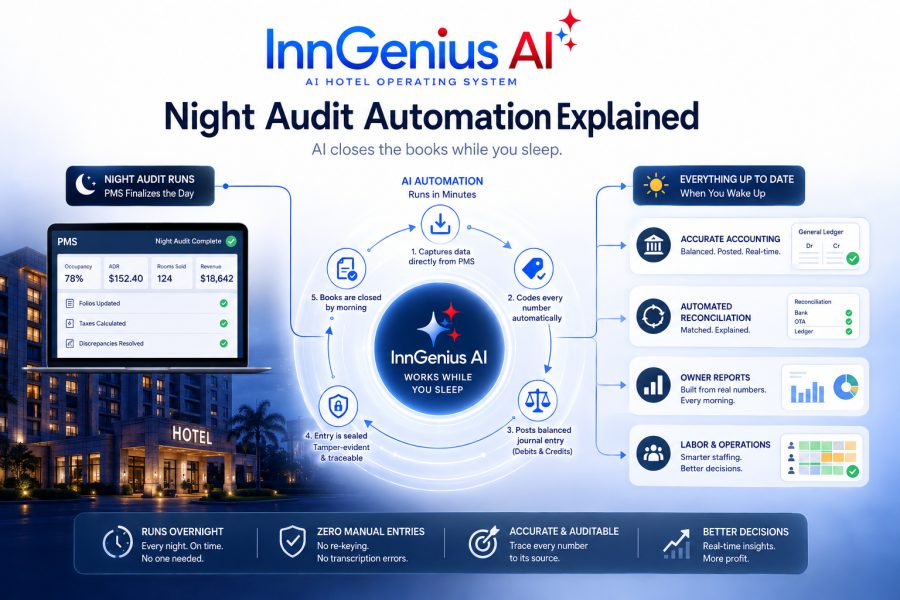
It reads the night audit itself. When the audit closes, the AI pulls the numbers directly, no export or re-entry required.
It codes and posts the accounting entries. Room revenue, occupancy tax, guest ledger movements — mapped to the right GL codes and posted as a balanced journal entry, both sides, in real time.
It reconciles automatically. The night audit against the ledger, the bank against the books, OTA remittances against what was actually booked — matched down to the folio, with any variance explained rather than just flagged.
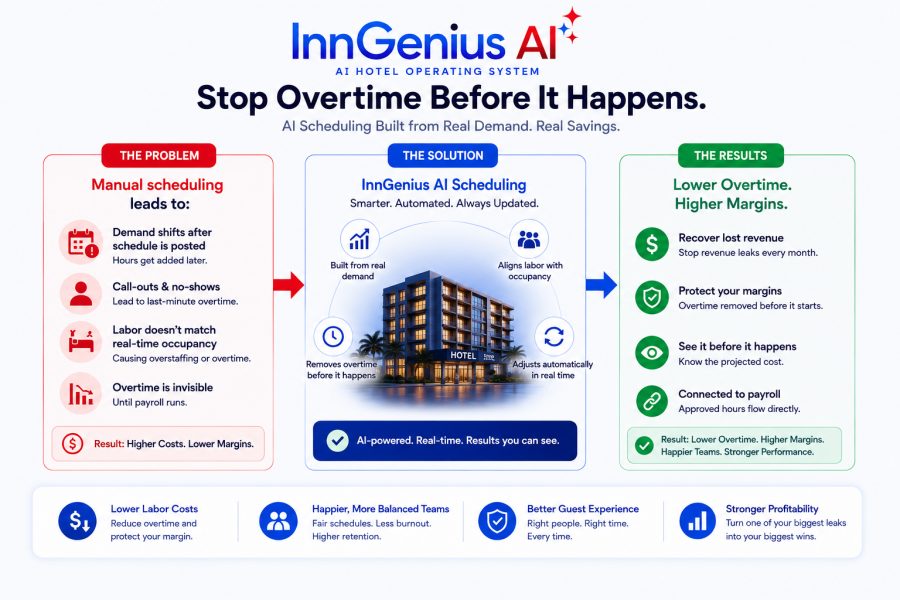
It reacts to changes during the day. A guest checking out two nights early isn’t just a front-desk update — it’s a chain of downstream effects: the folio closes, the cancellation policy applies, the OTA commission gets corrected, the room gets released and re-priced, housekeeping’s board updates, the revenue journal adjusts, and tonight’s labor plan trims itself. A system built to run the hotel handles all of that as one event, not nine separate manual updates across five tools.
It schedules labor against actual demand, not a fixed template, so overtime gets caught before it happens instead of showing up as a surprise on the labor report.
It writes the owner’s report before anyone’s awake, built from the same numbers that were posted overnight — not a separate spreadsheet assembled after the fact.
The difference between an AI hotel operating system and a typical software add-on comes down to one thing: where the numbers come from.
Most hotel tech stacks are a collection of separate systems that each hold their own version of the truth, reconciled by a person moving data between them. An AI hotel operating system is designed around a single ledger — every workspace (front office, housekeeping, bookkeeping, labor, engineering, owner reporting) posts to the same place, so there’s nothing to reconcile by hand because nothing was ever split apart in the first place.
That’s also why “zero manual entries” is a meaningful claim rather than a marketing line. It’s not that a human is doing the work faster — it’s that the handoffs between systems that used to require a human don’t exist anymore.
If you’re comparing tools in this category, a few questions cut through the noise:
A PMS runs your front desk. An accounting platform holds your books. A labor tool builds your schedule. An AI hotel operating system is the layer that connects all of it, does the manual translation work that used to sit between those systems, and hands you a closed, reconciled, explainable set of numbers every morning — without anyone keying anything in overnight.
For independent owners and small groups especially, that’s not a convenience feature. It’s the difference between finding out about a leak in next month’s meeting and catching it before it costs you the first dollar.
InnGeniusAI is the AI hotel operating system that runs your night audit, your books, and your schedule — on one shared ledger, with every number traceable back to its source.
Explore the platformWe’ll connect one property and show you the same ledger running your front desk, your books, and your schedule.
Book a demo
Seventeen AI workspaces, from the room board to the general ledger — the AI hotel operating system.
© 2026 InnGenius AI LLC · AI Hotel Operating System · Greensboro, NC
Founding pricing locked for the first 300 properties — see the whole flow in 20 minutes.
Book a demoBefore we start — mind sharing your name and email? I’ll only pass it to a real person if you want a follow-up.